Economics & Finance
Negative interest rates: what are they, and why are investors willing to pay them?
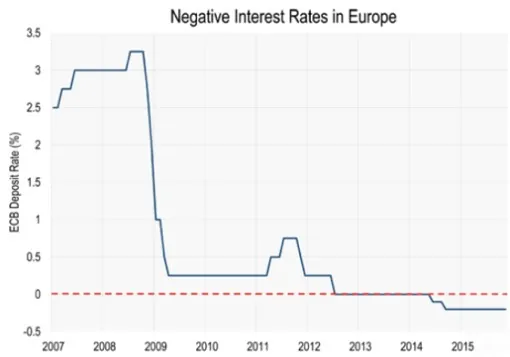
In 2014 the European Central Bank adopted a strongly expansionary monetary policy that resulted in negative interest rates on interbank deposits.
Negative rates are the product of an unconventional monetary policy, whose aim is to pull Europe out of the phase of recession and low inflation it is going through.
The ECB considers this necessary because, during periods of recession, people and businesses tend to hoard money, which leads to a fall in demand and investment. This has hurt the economy, causing output to fall and unemployment to rise. To counter this, over the years the ECB has always relied on expansionary monetary policy, that is, injecting new money into the economy in order to boost investment. In recent years, however, this “traditional” policy has proved insufficient, which is why the ECB started applying negative interest rates.
Negative interest rates work just like any other rate, but take values below zero. This means that whoever deposits money will, when the bond matures, see the amount reduced by a percentage equal to the interest rate.
If I deposit €100k and in a year’s time I get back a smaller amount of money, keeping money idle in bank deposits becomes relatively more expensive, and investing or spending it becomes more attractive.
Classical economic theory does not contemplate the idea of negative rates of return: according to it, investors expect a positive return proportional to the risk they take. In reality, in this historical period, there are people willing to lose a percentage of their money rather than see it grow, or at least stay the same, by investing in other assets.
Let us look at some possible explanations of why investors might want to put their money into something that will deliver certain losses:
§ Safety: Risk-averse investors who expect further rounds of recession and economic crisis may find it more worthwhile to buy negative-yielding bonds issued by economic giants such as Germany and Switzerland, considered relatively safe, rather than opt for other investments with a positive return but a high risk of default.
§ Lack of valid investment alternatives:
What may push investors towards such bonds is the lack of other investment options: investments with a positive rate of return offer very thin profit margins anyway.
§ Prospect of gains:
§ In the current low-growth environment, investors who buy negative-yielding securities may expect yields to fall further, allowing them to profit from their investments: investors could end up with a positive real return by investing in bonds with negative yields. For example, if a bond were yielding minus 1% but the consumer price index (CPI) fell by 2%, the investor’s purchasing power would still increase.
§ Since a bond’s price and its yield move inversely, if rates became even more negative the investor could make a capital gain, because the bond’s price would rise.
§ Negative-yielding bonds can also be used to speculate on certain market variables, such as exchange rates between currencies. Imagine two bonds, A and B. Bond B has a negative yield, lower than A’s. If the currency in which B is denominated appreciates, B may end up giving its holder a higher return than A.
Many questions about negative interest rates remain open. Some economists argue that the ECB’s measures are simply harmful, others think they are a complete lifesaver, and others still have no idea what to expect.
What will be the consequences of this kind of policy in Europe and around the world? How far can it go? What might it mean for banks and consumers?
Views expressed in articles are the authors' own and do not necessarily represent those of the association or of Bocconi University.
Inflation is always and everywhere a monetary phenomenon.
 Milton FriedmanInflation: Causes and Consequences, 1963